
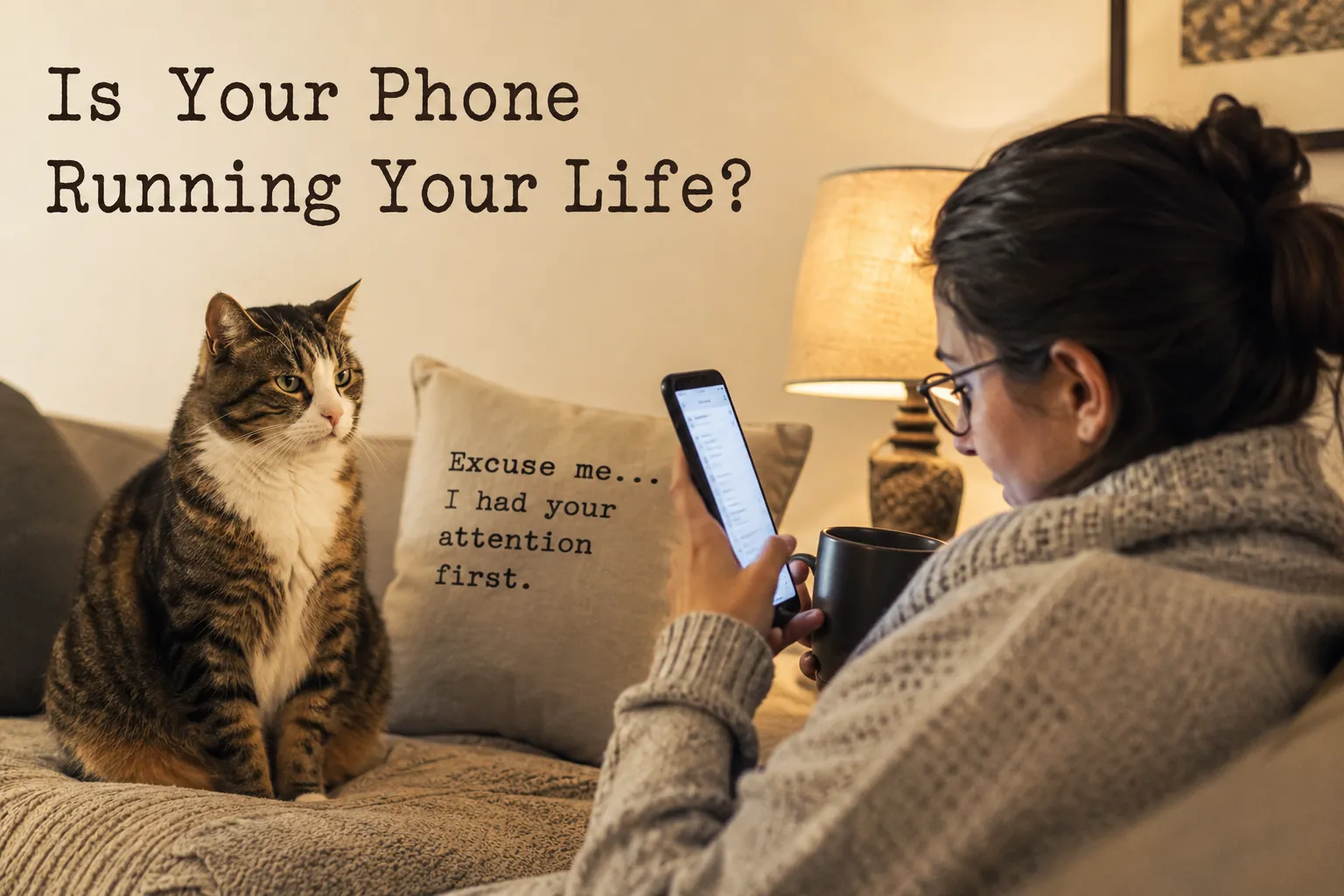
I was sitting in a café recently watching a couple in their twenties. They looked lovely together. Stylish, attractive, healthy. The sort of people advertisers use to sell us “connection.”
And for almost forty minutes neither of them looked at each other.
Both were endlessly scrolling. Occasionally one would laugh at something on their screen and show the other, who would nod briefly before disappearing back into their own little digital world.
It struck me how often I now see this. Families sitting together while being somewhere else entirely. Friends out for dinner checking notifications every few minutes. People walking into lamp posts because their heads are bent over glowing rectangles.
We laugh about it. But underneath the jokes there is growing anxiety, exhaustion and emotional disconnection.
Our phones are extraordinary tools. They help us navigate journeys, stay in touch with loved ones, run businesses and learn almost anything instantly. But many people quietly admit to me that they no longer feel fully in control of their relationship with technology.
They wake up and reach for the phone before their own thoughts.
They scroll long after they intended to sleep.
They feel strangely restless if the battery is low.
They cannot sit in silence for even a few moments without checking something.
And perhaps most importantly, they have forgotten what genuine mental rest feels like.
The human brain was never designed for constant stimulation. Every notification, every scroll, every tiny unpredictable reward gives the brain a little chemical “hit” which keeps us coming back for more. Over time this can increase anxiety levels, shorten concentration spans and create a constant background feeling of unease.
I often explain it to clients like this:
Imagine trying to relax while somebody taps you gently on the shoulder every thirty seconds.
Eventually your nervous system never fully settles.
That is what constant digital interruption does to many people.
I sometimes notice something else that gives me pause. A parent pushing a pram, phone in hand, eyes down, scrolling while the world passes by at walking pace.
There is nothing unusual about it anymore. It has become almost invisible in daily life.
And yet if we slow the moment down, there is something quite striking about it.
A baby or small child is in one of the most formative periods of life, constantly learning what connection feels like. They are wired to seek faces, eye contact, tone, presence. These are the building blocks of emotional safety.
When that attention is repeatedly pulled away by a screen, even in small moments, the child is still there, still sensing, still learning what “being with someone” feels like.
This isn’t about blame. It is about awareness.
Because most parents are not choosing disconnection. They are being quietly, repeatedly interrupted by a device that is designed to demand attention.
Children and teenagers are particularly vulnerable because their brains are still developing. But adults are not immune either. Some of the most stressed clients I see are highly successful professionals who secretly feel unable to switch off.
The good news is that the brain is wonderfully adaptable.
Just as habits are learned, they can also be unlearned.
You do not have to throw your phone into the sea or move to a cave in the woods. Small changes can have surprisingly powerful effects:
• Leaving the phone outside the bedroom
• Having screen-free meals
• Going for a walk without headphones or notifications
• Turning off non-essential alerts
• Allowing yourself moments of boredom again
Boredom, interestingly, is often where creativity, calmness and genuine thought begin.
Hypnotherapy can also help people regain that sense of control. Rather than relying on willpower alone, it works by calming the nervous system and changing the unconscious patterns linked to compulsive checking and emotional dependency on devices.
Most people do not actually want to spend half their lives staring at a screen.
They want peace. Presence. Connection. Sleep. Focus. Conversation. Calm.
Perhaps the question is not “How much time do I spend on my phone?”
Perhaps the better question is:
“How much of my life am I missing while looking at it?”